
 Image: Kelly Sikkema
Harnessing Healthy Eating Habits with Parental Guidance
PCI Certified Parent Coach®
Eating is one of our most important visceral experiences because we have to repeat it so often: three meals a day works out to 1095 meals a year. Although a clear understanding of nourishment, balanced diets, and appropriate portion sizes are vital to develop a healthy mind and body, we should also be seriously considering what the process of eating is like for our children.
If meals feel like a struggle, that’s normal. It can be a moment that can easily devolve into a desire for control. Maybe you’re familiar with these phrases: no spitting…, don’t play with that…, just one more bite and then I’ll give you dessert… Unfortunately a desire to bring manners and nutrition-focused objectives to the table can end up building tension or stress, which can affect listening and cooperation away from the table, too.
As always, let’s think about how you, the parent, are showing up to the table. Consider these questions:
- What are your expectations around food?
- What do you bring to the table from your own upbringing?
- Do you experience stress even before the meal begins?
- What are you physically doing during the meal? Seated, scrolling, busy in the kitchen?
- Do you use certain language around your child (“picky eater,” “don’t bother, she won’t eat that,” “he only eats white foods”) about their relationship to food to others?
The more we observe these patterns, the more we can recognize that they may no longer be helpful in making a necessary change to show up differently for our children. Learning to eat, trying new foods, and exploring tastes and smells is not fixed; it’s a path. We need to create a growth mindset about food, just like we would with any new activity our little one is trying to define for themselves.
So once you’ve considered how you’re showing up for your child, here are some shifts you can consider building into your newfound growth mindset:
Get out of your child’s way! Children are natural explorers. If we are able to remove restriction and control, it will give them more space to figure out things for themselves, slowly over time. What does that sound like?
- “You don’t have to eat it. It’s up to you to know what you want to try.”
- “You don’t feel like trying that right now, that’s totally fine.”
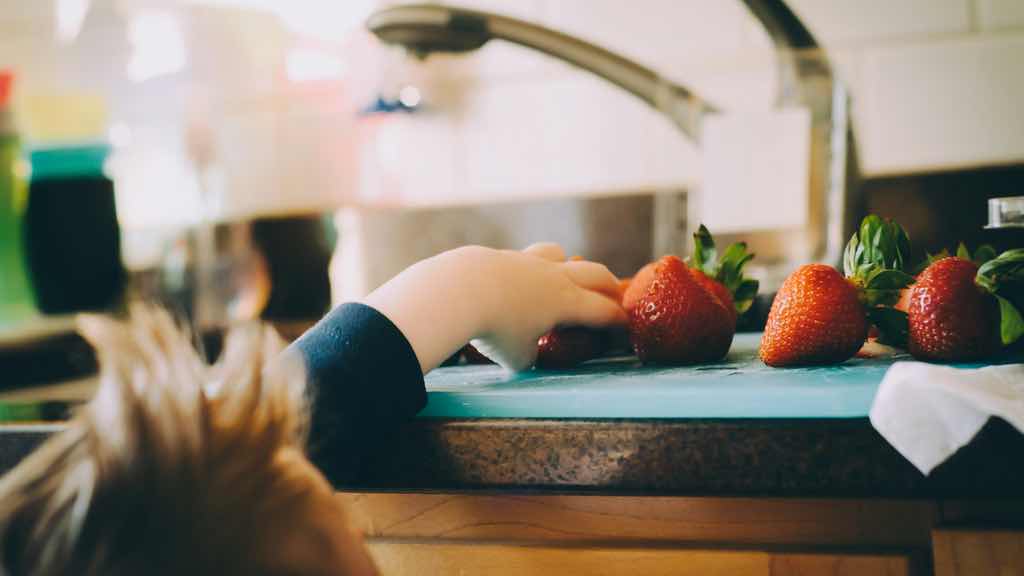
Share the exploration of food in a different way. Involve the child in various parts of “pantry to tummy” (from going to the market, to child-safe food prep, to the obvious: cooking, plating, setting the table, observing, smelling, touching…). Ask questions at every stage to create curiosity, instead of building pressure to perform or eat.
Handling food waste. No one likes to see anyone waste food. A good place to start is to be mindful about portion sizes, of course. But if we give a child paper and crayons to learn to draw, some crayons will break and paper will be thrown away, right? It’s similar to eating: it’s an activity that is being learned. Not every piece of food is going to be consumed during the process.
Help build manners and skills over time. If eating itself is a stressful moment, a great time to practice using a fork, knife, and spoon, can be a game away from the table. No need to add another request and constraint in an already tense situation. Manners are mostly built by observation, positive reinforcement, and practice: it takes time to integrate them into routine and muscle memory.
Spitting out food & understanding what they don’t like. For your children, spitting out food is not a sign of rudeness: it is the child deciding for themselves what they don’t like. Reframing this behavior as a normal developmental step can help parents approach mealtimes with more patience because part of any learning process means trying and exploring, as well as rejecting.
We can teach skills to remove food from one’s mouth if we don’t like the taste. It's healthy to reject something that only you can know whether you like, or not.
We don’t want our children to be 100% compliant in life. What if a friend, for example, is no longer kind and respectful? Should you stay in the friendship? We need to learn to know what we want, what is good for us at that moment, and what we can literally swallow: these skills can be taught around the table.
Model it, don’t teach it. Teaching can be unintentionally shame-inducing, and can lead to a list of do’s and don’ts that are not enjoyable. When you’re eating with a small child, try modeling how you’d like the child to change their approach.
Around a ‘picky eater:’ “I don’t know if I've ever had this type of cheese before… hmm, let me try smelling it… hmm, (add a description)… let me put it in my mouth and if I don't like it, I can take it out. Hmmm, (add a description) I’m not sure if I like it, let me taste it again…”
Around a child that gorges without pause: “I don’t know if you noticed that I tend to eat really fast sometimes. You know, I’m going to try to slow down a little bit, take three bites and then pause. Hmmmm, what do I like about this food? What do I want to eat next…?”
So, what’s the take-away from this article?
- Observe yourself and how you can modify your presence, speech, and intentions around the process of eating food.
- Model the behavior that you’d like to see your children embody.
- Involve your child and let them explore on their own terms.
Being at the table and sharing meals can be a great moment to bond and be present together. And with three times a day to practice, you’re sure to cultivate positive change.