
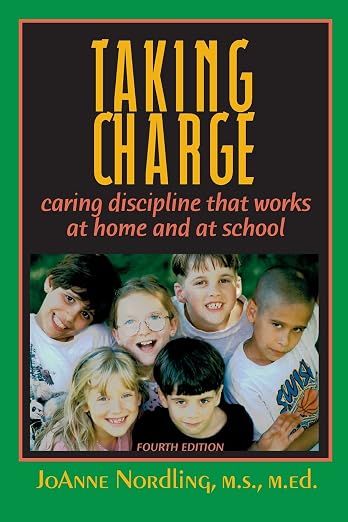
Book Review: Taking Charge: Caring Discipline That Works at Home and at School, by JoAnne Nordling
PCI Parent Coach in training
"Behavior you give emotional attention to will continue." That one sentence from JoAnne Nordling changed how I parent.
As a mom of four with a million things to juggle, I often struggle to give each child the attention they need, from love to discipline. Even with a background in counseling and child development and a shelf full of parenting books, I still feel lost at times. My son, an energetic and excitable four year-old whom I love deeply, is the one who pushed me furthest out of my comfort zone. After my girls, he was my first boy, and I was in new waters.
I have always found consistency hard, and discipline hardest of all. When he started kindergarten, he struggled with routines and with separation anxiety. I didn't want to become the parent who snaps from exhaustion, which is a real risk when four voices are talking at you at once. So, I looked at what was already working and where I could grow, and the answer was clear: consistency and holding boundaries, especially with him, because our bond makes it so hard to say no and mean it.
So, I did what every challenged mother does and spoke with my best friend. She recommended JoAnne Nordling's Taking Charge. I'll admit it was slow going at first for an overtired mom whose battery was at zero percent and whose brain mostly wanted mindless scrolling. But I stuck with it, and I was amazed at how well the book read me and my patterns.
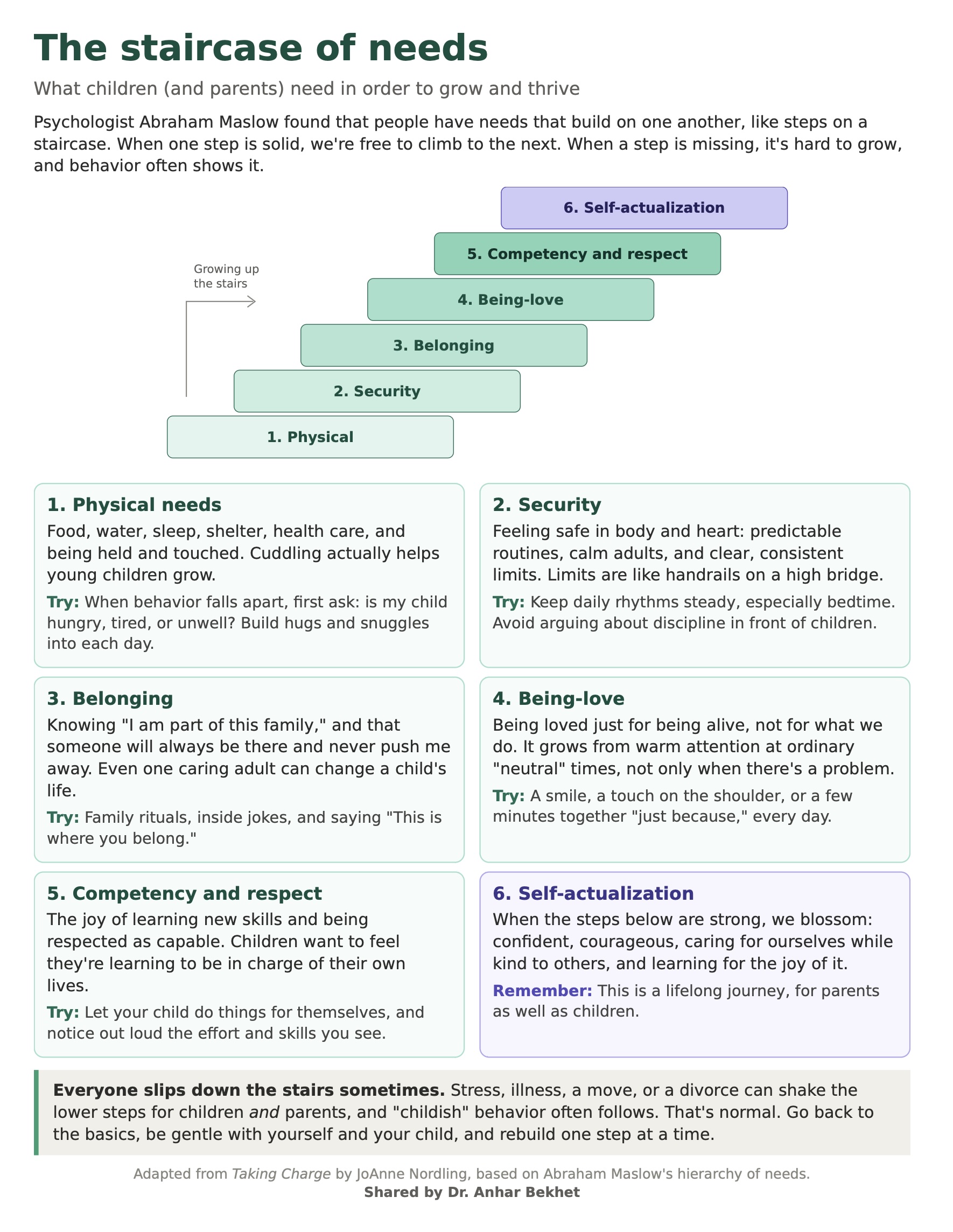
Taking Charge is a guide to disciplining children with love and respect, from toddlers to teens, at home and at school. (I read the fourth revised edition; the newest one is titled Caring Discipline.) Nordling builds on Abraham Maslow's hierarchy of needs, adapted into a "staircase" of children's needs, and her starting point is meeting a child's needs before correcting behavior. From there, her main idea is refreshingly simple: name the type of misbehavior, then use the correction that matches it.
Before she gets to a single correction, though, Nordling turns the spotlight on us. Her early chapters on paying attention are built around the sentence I opened with: whatever we react to, we get more of. Then came my favorite chapter, "How Parents and Teachers Sabotage Their Discipline." It was the holy grail for me. I was taking the right steps and had the knowledge, but something wasn't working, and I couldn't figure out what. Nordling names four everyday self-sabotages: procrastination, "talking and talking," forgetting to pay positive attention, and negative scripting. I recognized myself in the first two. Then she names the hidden ones, including the unmet needs of the adult. That one stopped me in my tracks.
Only after we've looked at ourselves does the book turn to the child. Nordling sorts misbehavior into four types: not-minding, self-indulgent, routine not-minding, and aggressive. She shows how to tell them apart and how to help a child problem-solve before a correction is even needed. Then she walks through the correction for each type, with relatable examples from homes and classrooms. I won't spoil the details here, because seeing them play out in her examples is what makes them click.
For me, the real test came when my son asked to play on the tablet and I said no. He started his familiar pattern: begging, then pleading, then crying, then a full tantrum, then threats to hit. In the past, I would keep talking and talking, explaining and re-explaining why the answer was no, until I was drained and he was still going. This time, I took a deep breath and tried what I'd learned from Nordling. I said no once, stopped talking, and ignored the behavior. To my surprise, he eventually stopped. That was Nordling's sentence in action: once the begging stopped getting my attention, it stopped.
The next day he tried again, and again I held my no without over-explaining. Then he threatened to hit, so I calmly told him, "Hitting is not allowed. If you hit, you will go to time-out." He did exactly what the book predicted and tested me to see if I would hold my boundary. So I followed through. The rule was simple: sit quietly for two minutes, and if you're not quiet, the timer starts over. Every time he screamed, I reset the timer and calmly repeated the rule. This went on for nearly 30 minutes. I stayed close and calm the whole time, reassuring him without words. I was screaming on the inside, but more determined than ever not to self-sabotage. Finally, after what felt like the millionth reset, he sat quietly for two full minutes. When the timer rang, I celebrated with him, and we went back to our day with plenty of positive attention.
We haven't had another incident like it in almost two months, and his tantrums are much smaller. When I say no, he knows I mean it. And because I now notice the neutral and positive moments and give him my attention during them, his staircase of needs is full, and we have far fewer tense moments than before. The same goes for my three girls. Our home is calmer, our patterns have changed, and saying no and meaning it has given us both a sense of security and trust.
As a PCI Parent Coach in training, I was delighted by how well this book fits an appreciative approach. Clear limits and warm connection aren't opposites; they're both/and. Nordling's staircase of needs echoes PCI's living systems view: instead of asking what's wrong with my child, I ask what my child needs to grow. Her advice to give attention at neutral times, love "just because," is the appreciative parental voice in action. And her focus on the adult's unmet needs is a reminder that parents are growing too, and a depleted parent can't hold steady.
The book also helped me let go of negative scripting, trading "my difficult child" for the whole, loving child in front of me. Behavior is often a signal of a need. Nordling's chapters on listening to a child's feelings and on family meetings, where children share responsibility and help solve problems, show how to meet the whole child rather than just manage the behavior. My biggest takeaway is that being firm and warm at the same time is what effective parenting looks like, and this book shows you how to do it day to day.
Taking Charge didn't give me a different child. It gave me a calmer, more consistent version of myself. I'd recommend it to any parent who loves their child fiercely and finds it hard to say no and mean it. So now it's your turn to ponder: what would change in your home if your no meant no, and your yes came with your whole heart?